Architectural opportunity
Centralize heavy components
Placing shared power and computing in a stationary central module reduces the mass carried by the articulated limbs.
IROS 2026 · Research project
Graduate School of Information Science and Technology, The University of Tokyo
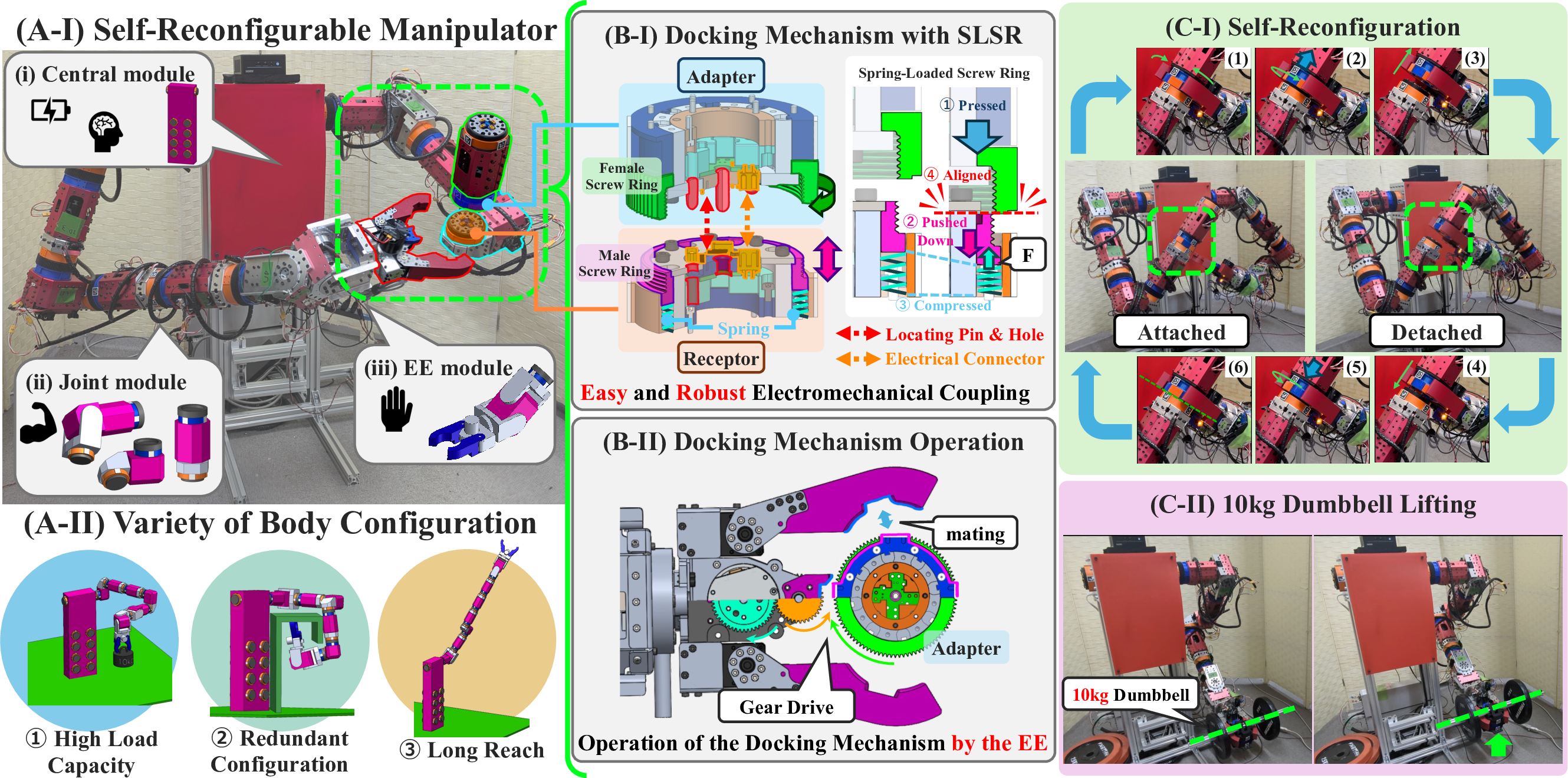
A spring-compliant, screw-driven dock enables a modular manipulator to align, connect, and disconnect tightly fitted mechanical and electrical interfaces—while keeping heavy shared components away from the moving limbs.
01 / Motivation
Self-reconfigurable robots can change their joint arrangement, link length, and reach for different manipulation tasks. Yet conventional modular systems often carry batteries and computers inside moving modules, increasing distal mass as the robot grows.
Our objective is to combine adaptable body configurations with the force capability of a practical multi-joint manipulator.
Architectural opportunity
Placing shared power and computing in a stationary central module reduces the mass carried by the articulated limbs.
Core challenge
Power must cross detachable interfaces. Compact connectors and locating pins need precise coaxial alignment, high insertion and extraction forces, and a rigid, low-backlash connection—all at once.
02 / Proposed approach
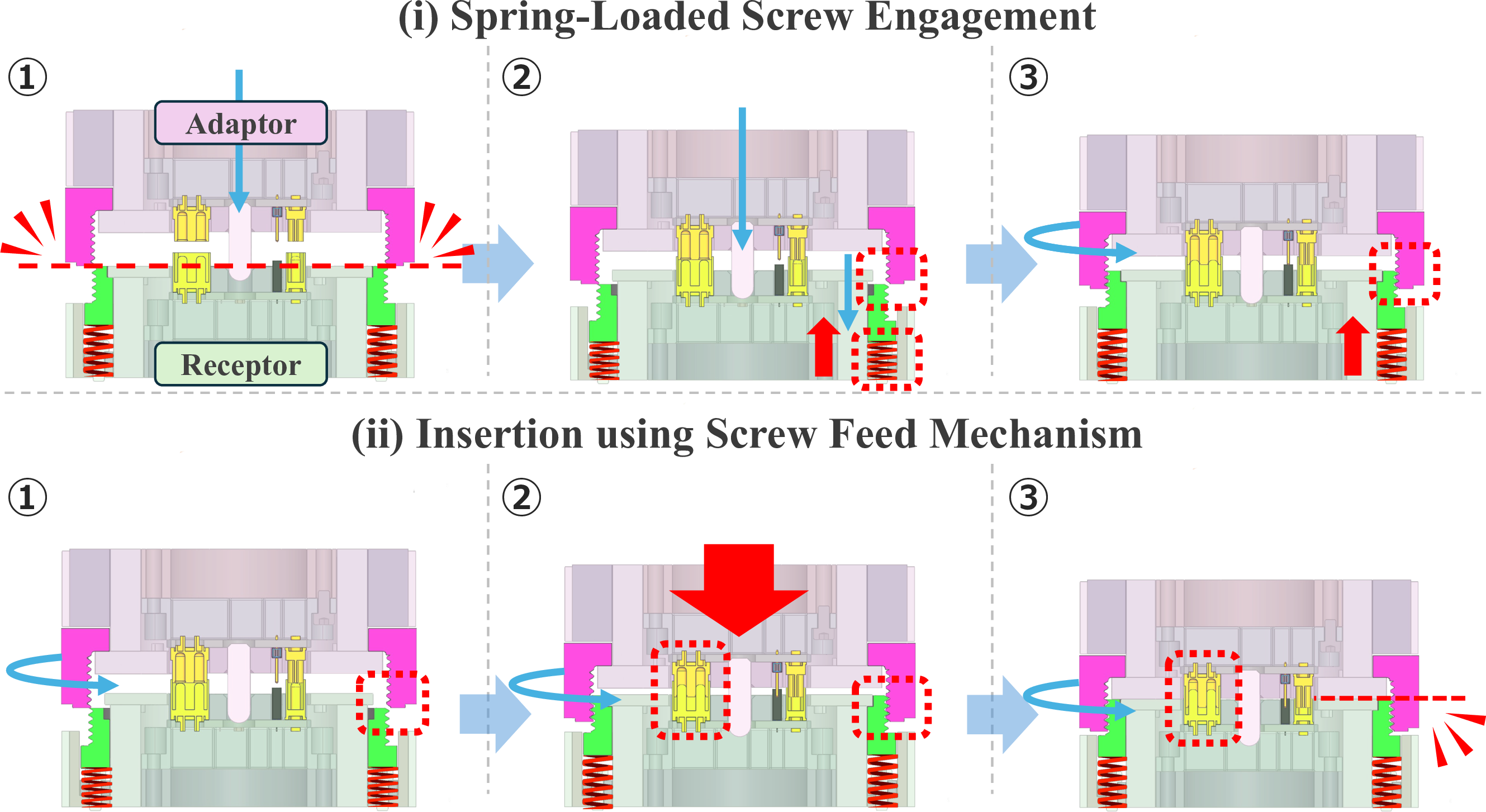
The Spring-Loaded Screw Ring (SLSR) separates reliable docking into a forgiving alignment phase and a forceful insertion phase.
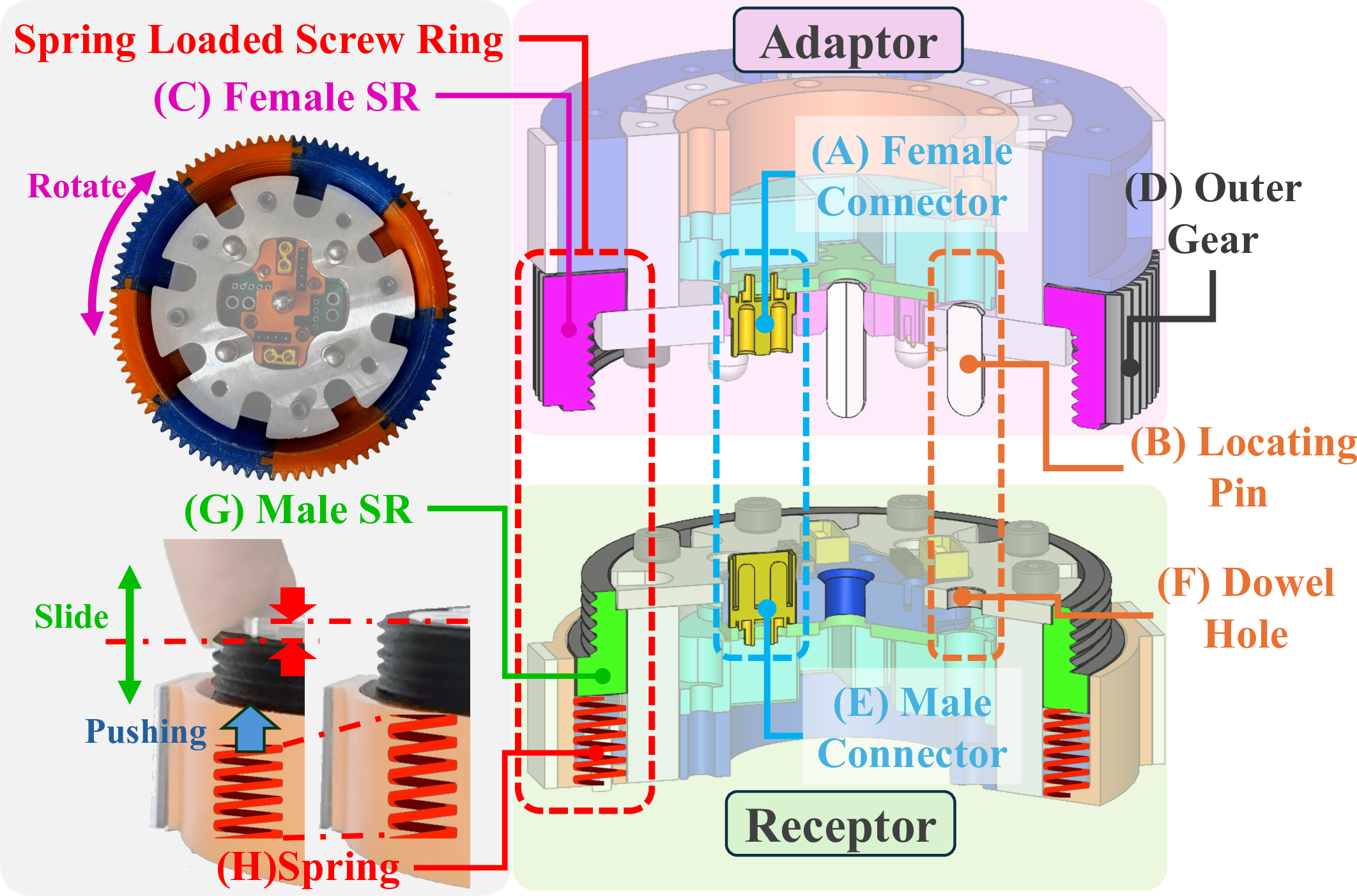
Spring-Loaded Screw Ring
The robot divides its functions among a central module, actuator-focused joint modules, and an end-effector module. The end effector drives the outer gear on the docking ring, so the robot can operate its own connections.
Mechanism in motion
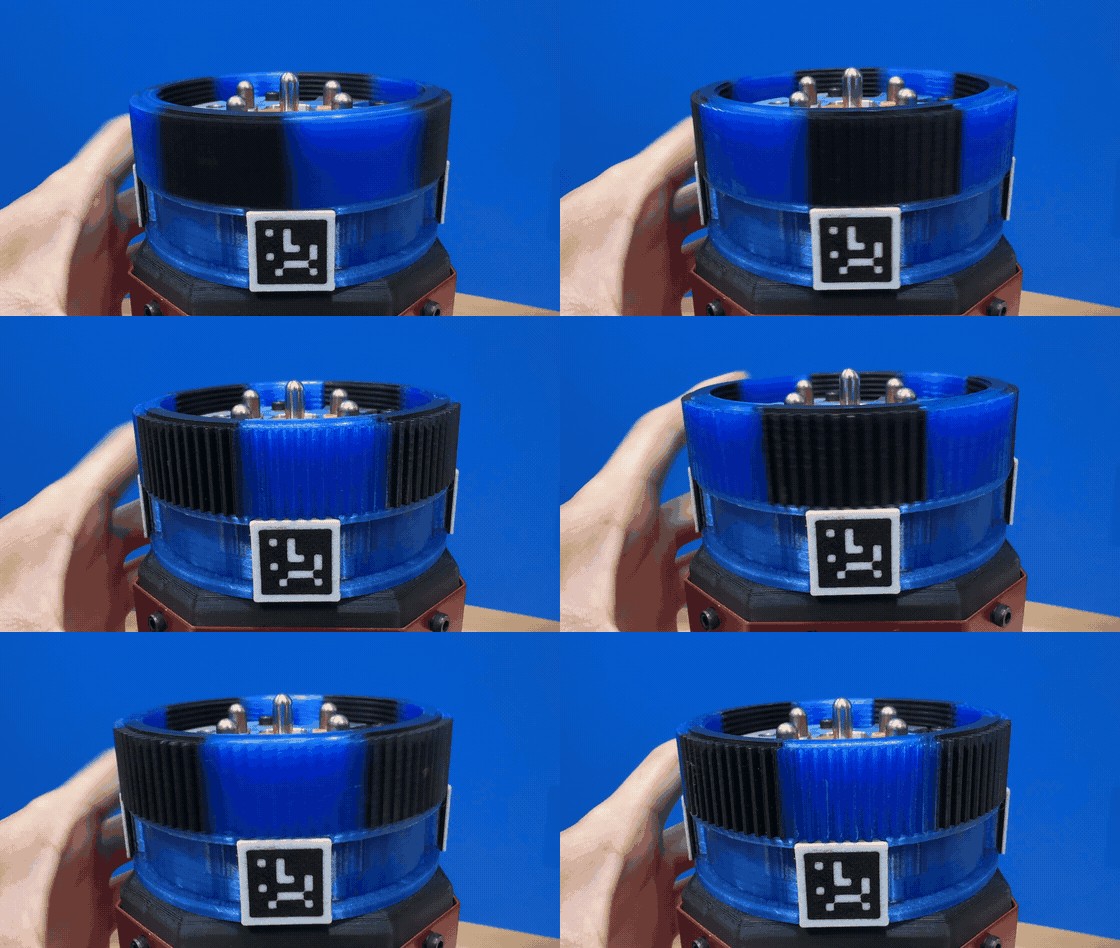
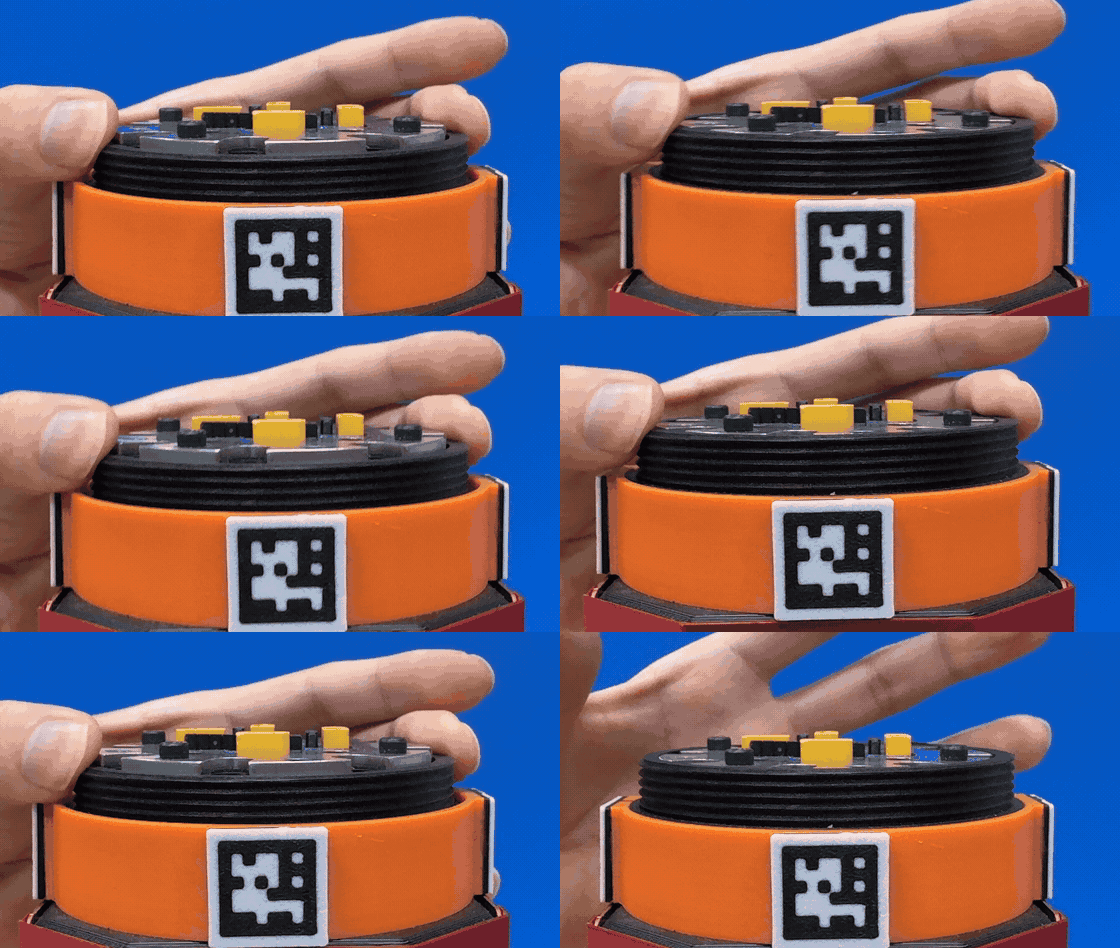
The end effector rotates the adapter-side ring, while spring-loaded translation on the receptor side maintains contact and alignment.
Docking sequence
Spring-assisted thread alignment absorbs small positioning errors before screw-generated thrust completes the tight fit.
03 / Experiments
The experiments measured the tight-fit load, isolated the contribution of spring compliance, demonstrated module exchange, and tested the strength of a seven-joint configuration.
Experiment A
Experiment overview
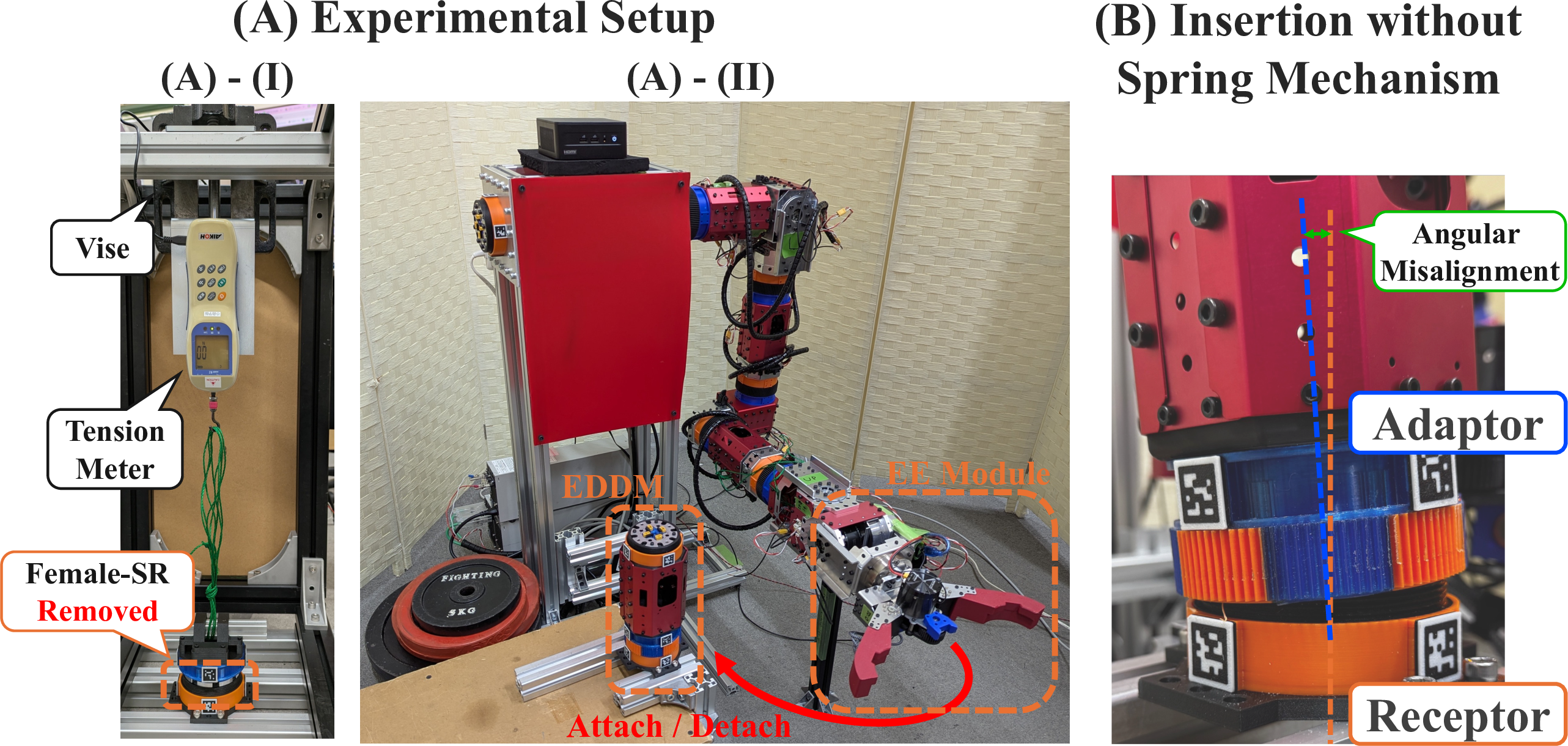
We first measured the force needed to separate the tightly fitted interface without screw assistance. We then repeated insertion and extraction ten times with and without the push spring to isolate its contribution to thread engagement.
Experiment B
Experiment overview
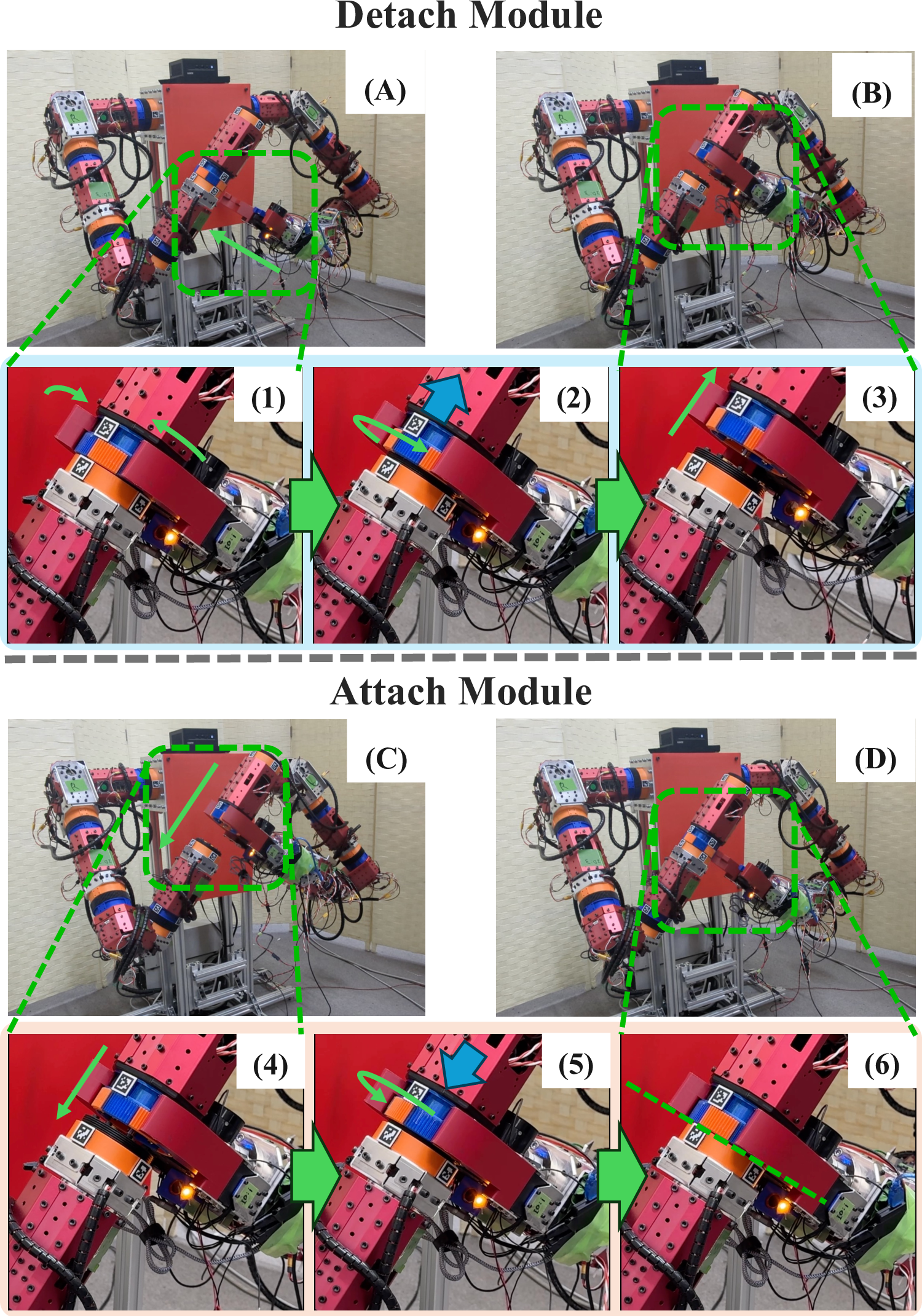
In a dual-arm configuration, the left end-effector module operated the docking ring to remove and reconnect the right-arm tip module. This confirms that the robot can manipulate its own interface rather than relying on external tooling.
Experiment C
Experiment overview
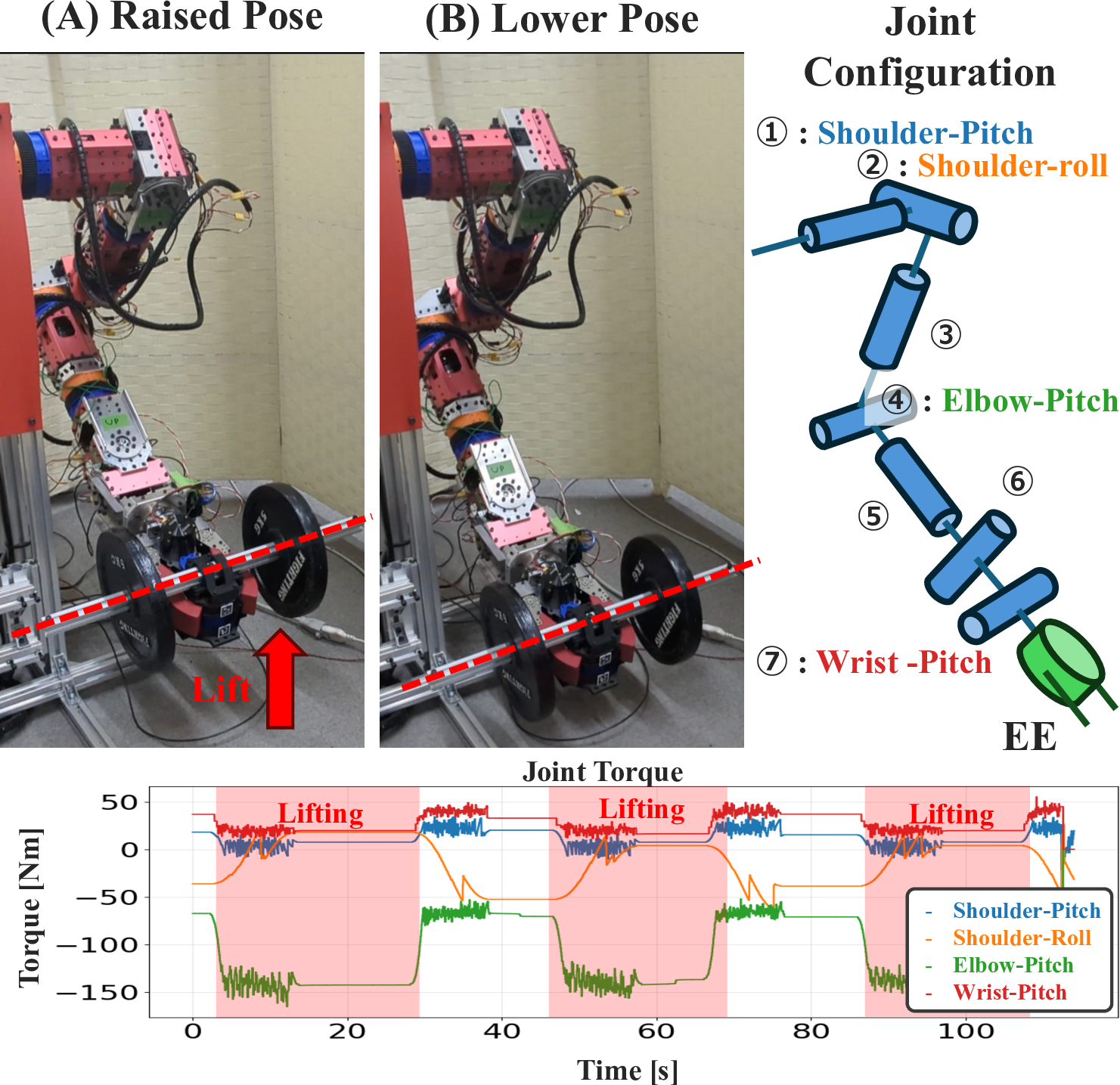
Five modules formed a seven-joint manipulator with six spatial end-effector degrees of freedom. The resulting arm lifted a 10 kg dumbbell three times to verify that reconfigurability and useful manipulation strength can coexist.
04 / Citation
Publication details will be updated when the final proceedings record becomes available.
@inproceedings{arimura2026slsr,
  author    = {Arimura, Toma and Kojima, Kunio and
               Hiraoka, Takuma and Konishi, Masanori and
               Hirai, Jin and Tada, Hiromi and
               Ishikawa, Ryota and Okada, Kei},
  title     = {Development of a Self-Reconfigurable Manipulator
               with a Spring-Loaded Screw Ring Docking Mechanism
               Enabling Tight Fitting Insertion},
  booktitle = {2026 IEEE/RSJ International Conference on
               Intelligent Robots and Systems (IROS)},
  year      = {2026}
}